Beauty salons
Beauty salon automation: what you can really take off the front desk

They just write.
Talk about salon automation usually starts with a chatbot. That's the wrong place to start. Start with a question: how many times a day does the front desk do the same action, and which of those actions don't need a person at all.
Below is a walk through the whole client journey, from the first message to the repeat booking. What's easy to hand off, what can be handed off with caveats, and what should never go to a robot.
What the front desk actually does
Watch a shift and the work splits into three parts.
The first is mechanical. Answering "how much is it", "do you have a slot on Thursday", "where are you located". Booking, rescheduling, reminding. Each action takes a minute, but there are dozens of them a day.
The second is human. Calming down an unhappy client, persuading someone who's hesitating, suggesting the right stylist for what the client wants, sorting things out when everything has gone wrong.
The third is working as an adapter. See a message in Instagram DMs, open YCLIENTS, find the client, book them, go back to the DMs, reply. Five switches for one booking.
Automation should take over the first and third parts. The second is the very reason a salon has a person at the desk.
Where bookings come from
A typical salon takes clients from at least five places: Instagram, WhatsApp, Telegram, phone calls and the website widget. Plus those who message a stylist directly.
The problem isn't the number of channels. It's that each one lives separately. The same client can write in DMs in the morning and call in the evening, and for the salon these are two different requests. The history is broken, and the front desk pieces it together again every time.
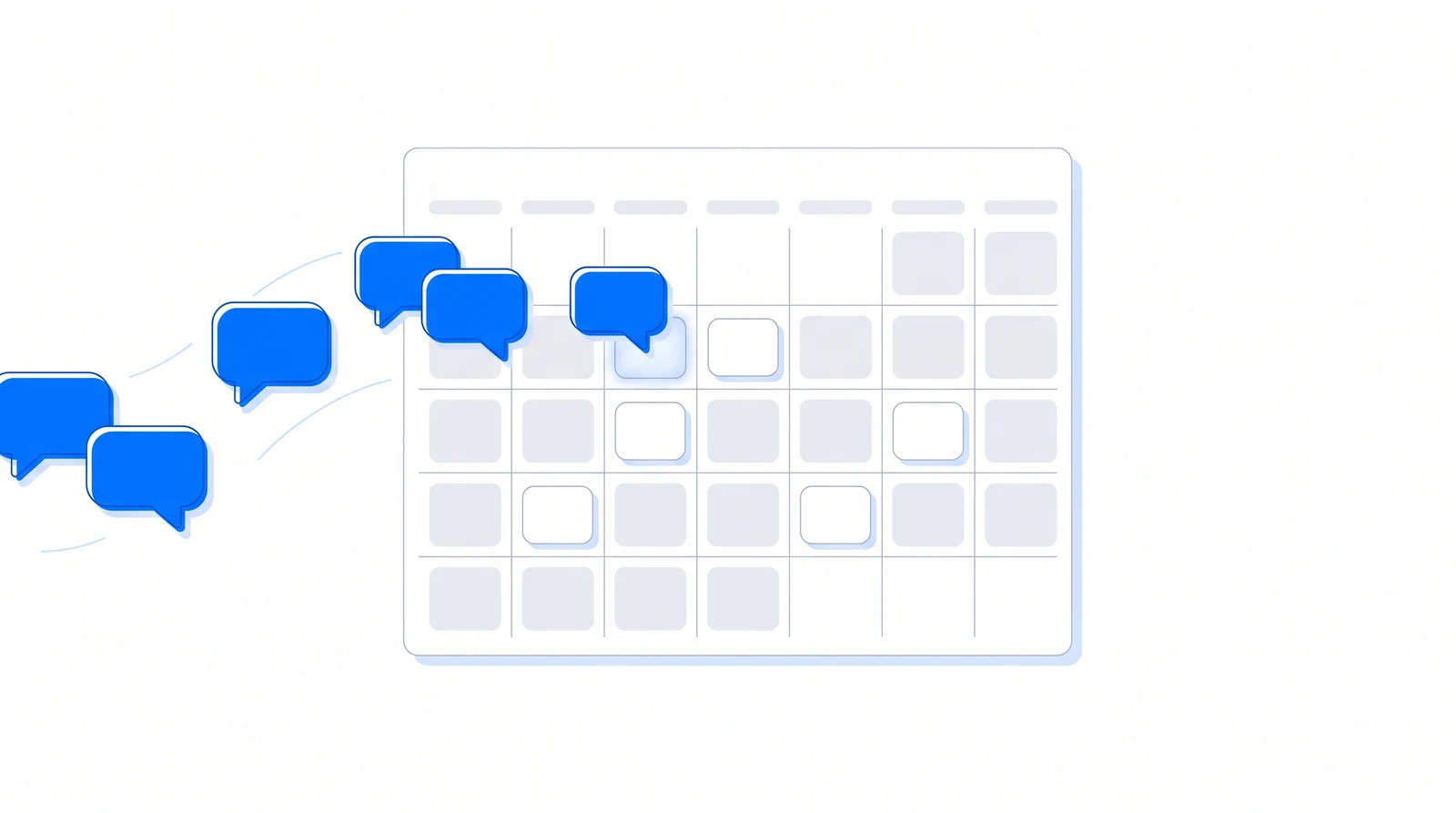
The first step of salon automation isn't a bot. It's a single inbox: all channels come together in one window, and next to each message you see right away who's writing, when they last visited and what services they come for.
Only after that does it make sense to turn on auto-replies. Otherwise the robot will be answering in one channel while a person digs for context in four others.
What happens at night and on weekends
This is the most obvious place where you lose clients, and the easiest one to automate.
A client decides to book in the evening, after work, exactly when the salon is closed. In the morning the front desk replies, but the person has already written to two other places and booked wherever they got an answer right away.
What you can cover here without risk:
- answer questions about prices and services, from the price list, not "roughly";
- show free slots for the next few days;
- make the booking if the client has picked a time;
- say honestly "we're closed right now, the front desk will message you in the morning" if the question is complicated. That's an answer too, and it's better than silence.
One important rule: only answer with what's been confirmed. If the price list isn't digitized, the robot will start making up prices, and that's worse than silence.
Connecting chats to YCLIENTS
This is where that adapter work lives. The client writes in DMs, the booking sits in the booking system, and a person runs back and forth between them.
What should happen on its own:
- Recognize the client. Find their card by phone number or handle and pull up their history: when they visited, which stylist, what services.
- Show real slots. Not "let me check", but the slots that are actually free with the right stylist.
- Create the booking. Right in the system, not "I'll put it in later when I get to it".
- Create a card for a new client. Once, with a duplicate check. Otherwise in six months one client will have three profiles and no history.
Duplicates are a pain of their own. A client wrote from her work number, then from her personal one, then a friend booked for her. In the reports that's three different people, and you can't calculate how many clients come back.
An audit breakdown: how much CRM work was done by hand and what changed in five weeks.

Reminders, reschedules and cancellations
A reminder a day before is the most obvious automation, and most salons already have it. What happens next is more interesting.
The client replied to the reminder. "Can't make it, let's do Friday." This is where automation usually ends, because the reply goes nowhere. It should turn into a rescheduled booking and a freed-up slot.
A slot opened up. It isn't an empty spot in the schedule. It's money. A canceled slot can be offered to people who asked "let me know if something opens up", or to those booked later who'd like to come sooner. Nobody does this by hand. There's no time.
The client didn't show up. Record it. Not to punish anyone, but to see the pattern. If someone misses a second time in a row, it's worth handling them differently.
Clients who stopped coming
The most underrated part. Every salon's database has people who used to come regularly and then disappeared. Nobody writes to them. Not because nobody wants to, but because it means exporting the database, sorting it and coming up with a message.
This is exactly the kind of work a rule does: if a client hasn't been in longer than their usual interval, write to them. Not a blast to the whole database, but a targeted message to those whose time is up.
The key is not to turn it into spam. One message, a clear reason, an easy way to unsubscribe. And only to those who agreed to receive messages.
Reviews
Asking for a review a few hours after the visit works better than a week later. But the front desk has no time, so it either doesn't happen or goes out to everyone, including those who left unhappy.
A sensible setup: first, briefly ask whether everything was fine. Ask a happy client for a review. Pass an unhappy one to the front desk instead of sending them to maps and review sites.
What should never go to a robot
The list is short, but breaking it is expensive.
- Conflicts. Ruined color, a burn, "I don't like the result". Always a person, and as fast as possible.
- Discounts and compensation. Anything involving money needs a person's decision.
- Medical questions. Contraindications, reactions, "is this okay with my skin" are not a topic for an auto-reply. For cosmetology it's also a matter of handling health data.
- Choosing a stylist for a complex job. A robot can show a list. It shouldn't give advice.
You can tell good salon automation not by a robot answering everywhere, but by the front desk finally having time to talk to people.
Where a salon should start
An order that works:
- Bring all channels into one window. No auto-replies yet. That alone cuts losses and switching.
- Digitize the price list and the rules. Without them there's nothing to answer with.
- Turn on answers to five standard questions. Price, address, free times, duration, how to prepare.
- Connect chats to the booking system. Recognize the client and create the booking without switching.
- Add work with open slots and clients who've gone quiet. This is about revenue, not about saving time.
And measure three things before you start: how many requests come in per week, how many of them arrive outside working hours, and how long you take to reply on average. A month later the same three numbers will show whether anything has changed.
We'll connect to your booking system and chats and calculate how much work is done by hand.
Questions and answers
Will clients realize they're not talking to a person?
Some will, and that's fine. What annoys people isn't a robot, it's a useless robot: one that answers off-topic and won't let you reach a person. If the answer is accurate and you can ask for the front desk at any moment, nobody minds.
We're a small salon with two stylists. Is this not for us?
Look at the number of requests, not the size. If you get fewer than fifty messages a week, start with one thing: an auto-reply outside working hours. The rest can wait.
We only work through Instagram. Is that enough?
Enough to start, but keep the risk in mind: the platform's rules limit automated messaging, so you need to use the official tools. Gray-area workarounds are cheaper right up until your account gets blocked.
What if the robot gives a wrong answer?
That's why it should only answer from the confirmed price list and rules, and at the slightest doubt, hand over to a person along with the conversation. And every answer should be saved so disputed cases can be reviewed.
How much time does it free up?
The honest answer: it depends on how much mechanical work you have. For a salon with a steady flow of requests it's hours a week. For a small one, tens of minutes. That's why you need a measurement before you start: it turns "it feels easier" into specific numbers.